Financial Services Data Platforms Are Fragmented, Siloed, and Complex. Here's How to Fix Them.
FIMA Europe 2024: data management beats AI as top priority. Break silos, shift quality upstream, expand real-time streaming.

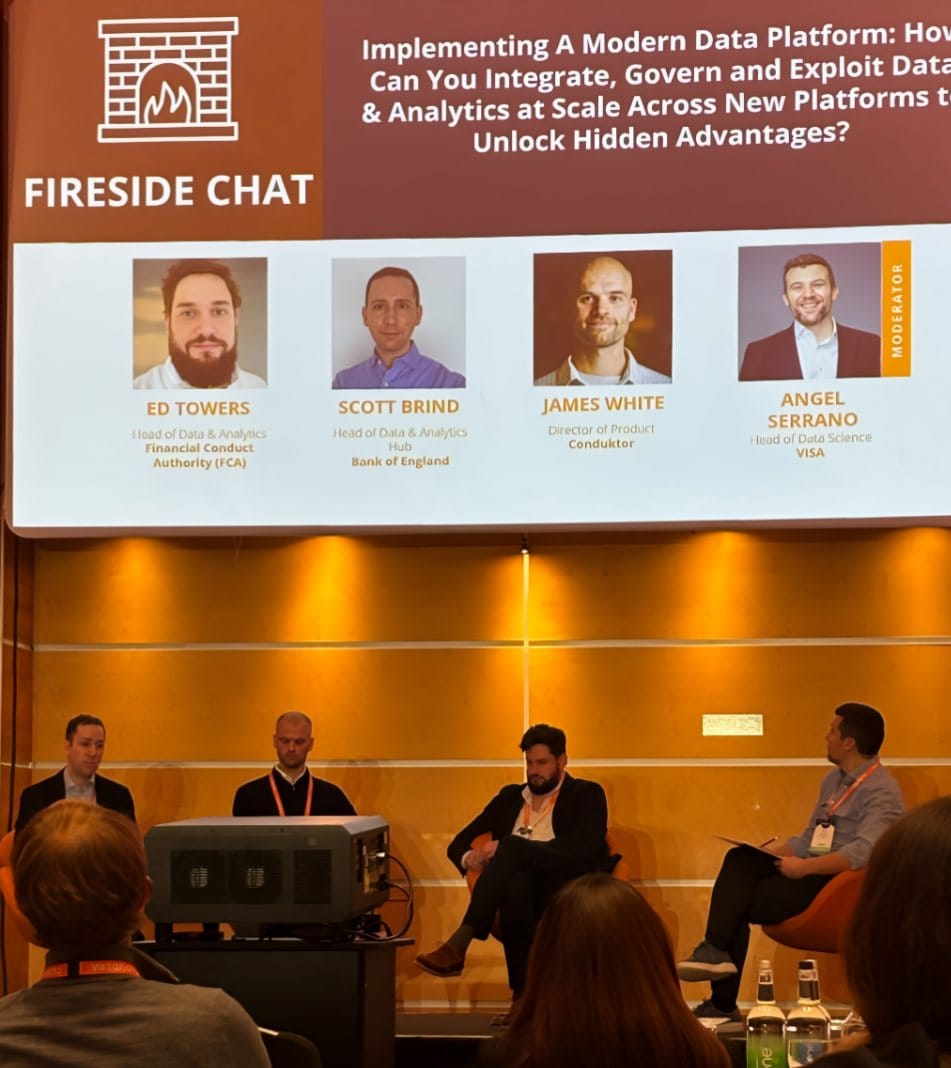
I attended FIMA Europe's Financial Data Innovation event in London last week and joined an Innovation Fireside Chat on modern data platforms. The audience polling results surprised me: data management will drive more innovation for investment banks and asset managers in 2025/26 than generative AI.
This reflects a hard truth. AI is useless without quality data to feed it. Every keynote speaker agreed: "innovation will only work with good quality data."
The head of data architecture at HSBC put it bluntly: "Data quality is still addressed as an afterthought."
Most Financial Data Architectures Are Broken
When asked to describe their current data architecture, participants used three words repeatedly: fragmented, siloed, and complex.
At Conduktor, I see this daily. These issues block data from becoming a strategic asset.
The rise of AI has made things worse. Organizations now need real-time, high-quality data, which forces them to rethink governance and security from the ground up.
Shift Quality Controls Upstream to the Streaming Layer
Traditionally, data quality and compliance controls live downstream in data lakes or warehouses. This approach creates problems: by the time you catch bad data, it has already polluted your pipelines.
Modern demands require a "shift-left" approach. Push those controls to the streaming layer. Protect and validate data at source. This improves utility for analytics and avoids downstream cleanup.
The shift is hard. Tooling is immature. Performance trade-offs exist. Skill gaps in distributed systems like Apache Kafka slow progress. Large organizations face inconsistent processes, redundant resources, and unclear ownership. Hybrid cloud and on-premise setups make everything worse.
Federated Data Governance Is Winning
60% of FIMA attendees are either fully invested in data mesh or considering it.
The goal: balance central oversight for compliance with decentralized autonomy for innovation. This is a long road, technically and culturally.
One of Europe's top financial institutions, managing over €1 trillion in assets, uses a federated governance framework. Platform teams enforce centralized standards. Developers own their data and applications. No bottlenecks. They expect 30% productivity gains and 25% faster project delivery.
Real-Time Streaming Goes Beyond Fraud Detection
Historically, real-time data in financial services meant credit decisioning and fraud detection.
That's changing. Organizations now use real-time streaming for operational insights and resource allocation. Timely, high-quality data flows across systems enable faster decisions and better customer outcomes.
Encryption Without Application Rewrites
A Swiss financial services company needed to migrate to cloud under strict encryption requirements. Using Conduktor's proxy architecture, they enforced encryption centrally without touching application code. They met regulatory deadlines and kept flexibility for future changes.
Unlocking Data Trapped in Mainframes
70% of Fortune 500 companies still run critical functions on mainframes. That data is often inaccessible to modern applications.
Streaming and middleware solutions solve this. Kafka Connect extracts data from legacy systems. Apache Flink unifies batch and stream processing for real-time use cases. This lets organizations decouple old and new environments, modernize incrementally, and keep legacy systems running while new systems consume data asynchronously.

Three Recommendations for 2025/26
If you're modernizing your data platform, focus on foundations:
- Embed data quality from the start. Don't treat it as an afterthought. Build governance and quality controls into your pipeline at the streaming layer.
- Break down silos. Foster cross-functional collaboration. Build a unified approach to data management.
- Expand real-time streaming. Go beyond fraud detection. Use it for operational insights and faster decision-making.
If you want to learn how Conduktor helps companies like ING, Capital Group, and Credit Agricole, reach out to us.