FlixBus: Data Mesh for 50+ Teams
FlixBus scaled Kafka to 50+ teams and 2,300+ topics with Conduktor's data mesh architecture and federated governance.
- Data mesh architecture
- Team autonomy and self-service
- Instant payment processing
- Real-time fraud detection
- 50+ teams working independently with Kafka
- 2,300+ topics managed
"Conduktor easily integrated with our CI/CD pipelines to enhance data governance. It's given us the tools to centralize compliance standards across the business, while allowing team-specific autonomy to speed up our processes." - Taras Slipets, Staff Data Engineer at Flix
Executive Summary
Flix scales Kafka data-streaming operations from 25 to 50 teams with Conduktor—optimizing fleet tracking, route efficiency, and AI-driven customer experiences across Europe and North America.
Kafka at Flix
Operating at the crossroads of a tech startup, e-commerce platform, and transportation company, data is the lifeblood of Flix. Kafka plays a critical role in managing vast streams of real-time data, from vehicle locations to customer feedback, enabling Flix to:
- Dynamically modify bus schedules on-the-fly
- Optimize routes by analyzing traffic patterns and vehicle data
- Rapidly respond to customer feedback, enhancing service quality
Challenge
As Flix expanded, so did the complexity of its Kafka infrastructure. Within five years, Kafka utilization expanded to over 2,300 topics and 9,500 partitions across 10 domains and 50 teams.
"We looked for solutions to significantly simplify the process. We didn't want to write our own tool for that kind of synchronization." - Taras Slipets, Staff Data Engineer
Managing a data operation of this size presented multiple challenges:
- Complex permissions — Managing access controls across global teams while adhering to local data governance and privacy regulations
- Access bottlenecks — No single interface for technical and non-technical users to independently access Kafka data
- Limited discoverability — Analysts struggled to discover available data, view schemas, and filter streams without a platform for observability
- Cost management — Without a unified view, proactively consolidating data pipelines to prevent runaway costs was challenging
Solution
At Flix, robust data security is paramount. The sensitive nature of payment transactions and personal information required for travel bookings made data protection a critical concern.
Flix adopted a resource-centric approach grounded in data mesh principles, giving teams ownership of their data within a federated control framework.
Data mesh approach
- Resource-focused permissions — Permissions tied to resources, centralizing control over crucial assets
- Distributed governance — Resource owners manage access to their respective resources
- Centralized framework — All oversight remains under a cohesive framework ensuring consistency and compliance
Modular data architecture with Conduktor
Flix implemented a modular architecture using individual YAML files for each team's Kafka resources:
- Clear ownership — Clearly identifies the team responsible for resources within a namespace
- Contained leakage — Limits problems with overly lenient access settings to affected resources
- Auditable changes — CI/CD tools track all changes with merge history
- Promotes collaboration — Teams request access through pull requests; owners approve without centralized authority
How it works
Flix's federated Kafka security management operates through open-source technologies and structured CI/CD workflows:
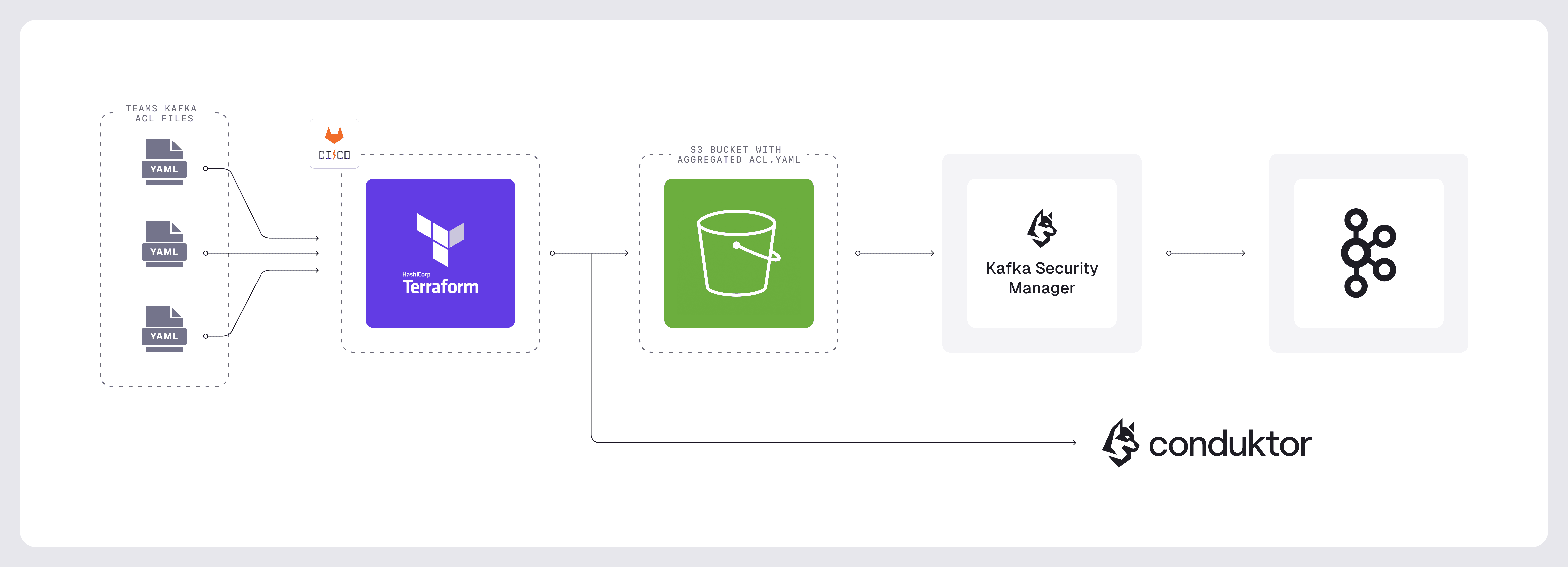
- Each team has a Kafka resource-oriented YAML file defining the owner and permissions granted to other teams
- Changes trigger CI/CD workflows that validate configurations through federated governance
- Files are transformed into a format compatible with Kafka Security Manager (KSM), a Conduktor open-source project
- The same files propagate permissions into Conduktor for interaction and troubleshooting
This workflow ensures each team is responsible for their resources while permissions are uniformly applied:
- Kafka ACLs — Control application access, ensuring only authorized applications interact with specific topics
- Conduktor RBAC — Provide team members with permissions to manage, monitor, and troubleshoot their Kafka resources
Results
Through collaboration with Flix, Conduktor developed a self-service framework enhancing collaboration between Platform and Application teams:
- 50+ teams working independently with Kafka
- 2,300+ topics managed across 10 domains
- Reduced reliance on central teams with intuitive self-service controls
- Automated compliance with configurable approval workflows
- Enforced best practices on Kafka configurations, maintaining consistency
Frequently Asked Questions
What is a data mesh approach to Kafka governance?
Data mesh is a decentralized approach where teams own their data within a federated control framework. Flix uses resource-focused permissions with distributed governance while maintaining centralized oversight for consistency.
How does Flix manage Kafka permissions across 50+ teams?
Flix uses individual YAML files for each team's Kafka resources, tracked in CI/CD with merge history. Teams request access through pull requests that resource owners approve without centralized authority.
What is Kafka Security Manager (KSM)?
KSM is a Conduktor open-source project that transforms YAML configurations into Kafka ACLs. Flix uses it alongside Conduktor RBAC to control both application and team access.
Read more customer stories
Published on January 10, 2025 by Stéphane Derosiaux